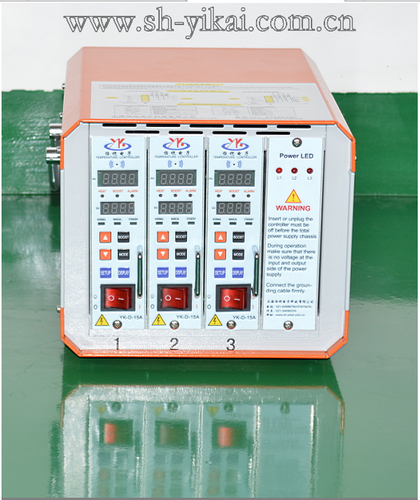
Temperature Control Principle of Temperature Control Cabinet
A temperature control cabinet is a device that continuously maintains the required temperature value. It mainly detects the temperature of heating elements through an intelligent computer chip (MCU) inside the meter core, then processes the data internally through the intelligent computer and outputs a proportional current value to achieve temperature control. The accuracy and stability of temperature control mainly depend on the following important factors:
1》 Temperature Measurement: Sampling cycle parameters and data filtering processing determine the temperature, while temperature compensation of the measurement circuit determines the temperature measurement accuracy;
2》 PID Control: Adjusts the proportional output current, with relevant parameters including proportional band, integral time, and derivative time;
3》 PIDD Control: Controls through phase angle, with relevant parameters including proportional band, integral time, and derivative time;
4》 Automatic Adjustment: Automatically provides the function of dominant factors by analyzing the capacitance of the heating wire and the thermal constant of the mold (it can accurately control the temperature when latent heat factors and unpredictable heat dissipation factors affect the temperature).
5》 Output Mode: Can be changed according to the environment
PWM (PIDD) Mode: Can achieve precise temperature control, but the power supply noise is much larger than that of SSR mode. SR (PID) Mode: Has small current noise, but its ability to control specific temperatures is worse than PWM mode.
Function Description
1》 Adopts FUZZY PIDD control technology, which can automatically adapt to any heating model without tuning PID parameters, greatly improving work efficiency
2》 Automatic ambient temperature linear compensation makes the temperature value of the controller more accurate
3》 Automatic cold junction compensation of thermocouple avoids relative errors caused by ambient temperature changes
4》 Automatic control function for thermocouple (temperature sensing wire) disconnection: If the temperature sensing wire is disconnected under constant temperature condition, the temperature controller will automatically memorize the constant temperature parameters after alarming, then continue to control. The hot runner of the mold can be repaired after product production is completed, thus avoiding losses caused by production stop due to thermocouple disconnection.
5》 Alarm Protection Functions:
Alarm for missing neutral wire or incorrect power wire connection
Alarm for hot runner power wire short circuit
Alarm for hot runner temperature sensing wire short circuit
Alarm for hot runner power wire open circuit
Alarm for hot runner temperature sensing wire disconnection
Alarm for incorrect connection position of hot runner power wire and temperature sensing wire
Alarm for reverse connection of temperature sensing wire positive and negative poles
High temperature alarm
Low temperature alarm
Alarm for thyristor damage
Alarm for excessive power
Alarm for fuse damage
Alarm Information Comparison Table
Fault Information | Fault Cause |
 | Power supply error |
 | Heating wire short circuit |
 | Incorrect connection of heating wire and temperature sensing wire |
 | Heating wire open circuit |
 | Temperature sensing wire open circuit |
 | Abnormal temperature measurement |
 | Reverse connection of temperature sensing wire |
 | Thyristor damage |
 | Test loop break |
 | Current overload |
 | Fuse F1 damage |
 | Fuse F2 damage |
Technical Parameter Table
Item | Parameter |
| Input Voltage | 185-250VAC |
Power Frequency | 50-60HZ |
| Operating Temperature | -20—60℃ |
Storage Temperature | -30—70℃ |
Fuse | 15A6×30mm |
Thermocouple | J, K adjustable |
Temperature Setting Range | 45—537℃ |
Sampling Speed | 0.1S |
Temperature Measurement Accuracy | 0.1℃ |
Temperature Control Accuracy | ±0.5℃ |
Control Mode | PIDD or PID |
Output Power | 0—3.6KW |
Factory Settings of Functional Parameters
Item | |
Thermocouple Model | Type J |
Over Temperature Alarm Upper Limit | 30℃ |
Low Temperature Alarm Lower Limit | -30℃ |
Temperature Unit | Celsius (℃) |
Control Mode | PIDD |
Soft Start Mode | ON (Enabled) |